
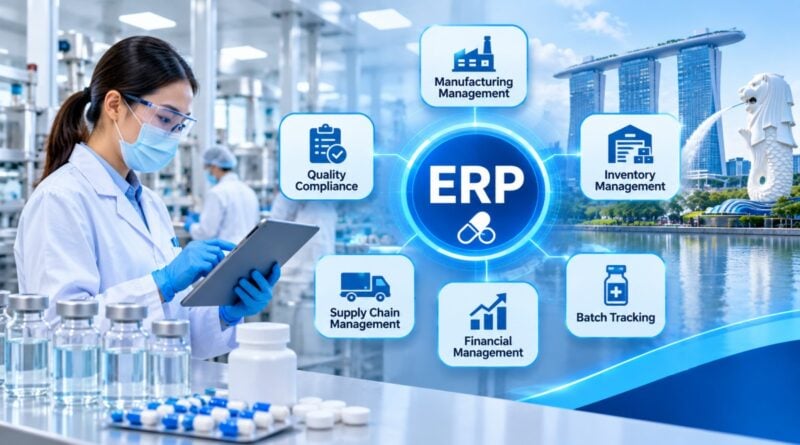
ERP Software Development for Singapore’s Pharmaceutical Industry
Singapore’s pharmaceutical industry operates in a highly regulated environment where accuracy, product quality, inventory control, and timely distribution are essential. Pharmaceutical manufacturers, distributors, and healthcare suppliers must manage complex processes while maintaining strict standards for product safety and regulatory compliance.
Traditional business software may not provide the flexibility required to handle these responsibilities. Disconnected applications, manual documentation, and limited inventory visibility can create operational difficulties.
This is where ERP development becomes valuable. A well-designed Enterprise Resource Planning (ERP) system connects important business functions through a centralised platform, helping pharmaceutical companies manage operations more efficiently.
With growing digital adoption, ERP development in Singapore is becoming an important consideration for pharmaceutical businesses looking to improve productivity, strengthen compliance processes, and modernise their operations.
1. Streamlining Pharmaceutical Manufacturing Operations
Pharmaceutical manufacturing involves several interconnected activities, including raw material purchasing, formulation, production planning, quality inspection, and packaging.
Managing these processes separately can create communication gaps and production delays.
Custom ERP software brings manufacturing activities together in one system. It helps businesses coordinate production schedules, monitor work orders, manage material requirements, and track manufacturing progress.
Features such as production planning, Manufacturing Resource Planning (MRP), and automated workflow management help organisations improve resource utilisation and maintain consistent production processes.
2. Improving Inventory and Batch Management
Inventory management is particularly important in the pharmaceutical sector because many products have specific storage requirements and expiration dates.
An ERP solution can provide better control over:
-
Raw materials and pharmaceutical ingredients
-
Finished products and packaging materials
-
Batch and lot identification
-
Expiry date monitoring
-
Warehouse stock levels
-
Supplier and purchase records
Batch tracking allows businesses to identify where particular products originated and where they have been distributed.
First-expiry-first-out (FEFO) inventory management can also help reduce the risk of expired stock remaining in circulation.
These capabilities improve inventory visibility and support more organised warehouse operations.
3. Supporting Regulatory Compliance and Quality Management
Pharmaceutical companies must maintain accurate records throughout manufacturing, testing, storage, and distribution.
A specialised ERP system can support quality management by centralising documentation and making important operational records easier to retrieve.
Useful functionalities include:
-
Electronic document management
-
Quality inspection records
-
Batch manufacturing records
-
Audit trails and user activity logs
-
Standard Operating Procedure (SOP) management
-
Corrective and Preventive Action (CAPA) tracking
ERP software can also be configured to support relevant regulatory requirements, including applicable Good Manufacturing Practice (GMP) procedures and electronic record controls.
However, implementing ERP software alone does not guarantee regulatory compliance. Businesses must validate systems and establish appropriate procedures according to their regulatory obligations.
4. Strengthening Pharmaceutical Supply Chain Management
Pharmaceutical supply chains involve manufacturers, raw material suppliers, logistics providers, distributors, and healthcare organisations.
A lack of coordination between these stakeholders can affect product availability and delivery schedules.
ERP development helps connect purchasing, inventory, warehouse management, and distribution activities.
Managers can monitor supplier performance, track purchase orders, review stock movements, and coordinate product deliveries through integrated workflows.
For Singapore pharmaceutical businesses working with regional and international suppliers, improved supply chain visibility can support better planning and operational coordination.
5. Automating Financial and Administrative Processes
Apart from manufacturing and inventory, pharmaceutical companies also handle extensive financial and administrative activities.
ERP software can simplify these responsibilities by connecting accounting, procurement, payroll, sales, and expense management.
For example, when a purchase order is approved, the system can update purchasing records and support the corresponding financial workflow.
Automated invoice processing, payment tracking, expense monitoring, and financial reporting can reduce repetitive administrative work.
This allows employees to spend more time on activities that directly support business performance.
6. Integrating ERP with Laboratory and Business Systems
Pharmaceutical organisations often use specialised applications for laboratory testing, production monitoring, and customer management.
A flexible ERP platform can integrate with suitable third-party systems, including:
-
Laboratory Information Management Systems (LIMS)
-
Manufacturing Execution Systems (MES)
-
Customer Relationship Management (CRM)
-
Warehouse Management Systems (WMS)
-
Business intelligence and reporting tools
These integrations help reduce duplicate data entry and improve information exchange between departments.
Integration requirements should be carefully designed to maintain data accuracy, security, and system reliability.
7. Why Custom ERP Development Matters for Singapore’s Pharmaceutical Companies
Every pharmaceutical organisation has different operational requirements. A manufacturer may need advanced production planning, while a distributor may prioritise warehouse management and product traceability.
Custom ERP development allows companies to build software around their specific workflows instead of depending entirely on standard features.
Businesses can select relevant modules, establish user permissions, integrate existing applications, and introduce additional functionality as their requirements change.
Choosing experienced ERP development professionals also helps organisations plan system architecture, implementation, testing, and ongoing technical support.
Conclusion
The pharmaceutical industry requires accurate information, controlled processes, efficient inventory management, and reliable documentation. ERP development can bring these business functions together through an integrated platform that supports operational efficiency and better decision-making.
For companies exploring ERP development in Singapore, investing in a solution tailored to pharmaceutical operations can help simplify manufacturing, improve batch traceability, strengthen quality management, and create better supply chain visibility.
SerpentCS helps businesses explore customised ERP development solutions designed around their operational workflows and industry requirements, supporting their journey towards more connected and efficient business management.